

Luxury Beefs
What looks like chaotic online discourse is, in fact, a system for converting grievance into status, influence, and power.


Introduction
Throughout history, elite rivalry has been a persistent feature of complex societies. In Secular Cycles, Peter Turchin shows that these rivalries move through long structural phases: periods of integration, in which competition remains broadly productive, and periods of disintegration, in which it becomes zero-sum and destructive.
These cycles unfold over generations, making them difficult to perceive from within.
This essay examines how these dynamics are playing out in our current “Age of Discord” by bringing together Venkatesh Rao’s concept of the Internet of Beefs, and Rob Henderson’s Luxury Beliefs hypothesis. While each is compelling on its own, taken together, they help explain how intra-elite competition operates in the modern attention economy.
In every era, elite conflict has involved battles over ideas, as individuals compete for status and influence by promoting particular viewpoints. Modern communication technologies have dramatically accelerated this process, but they did not create it. Drawing on thousands of years of history, Turchin’s work shows that intense intra-elite competition is a recurring feature of disintegrative phases, long predating the internet.
The Internet of Beefs describes the economic logic of modern online conflict: a system that rewards attention, amplifies grievance, and sustains ongoing antagonism. Luxury Beliefs explain how individuals position themselves within that system, using symbolic signals to differentiate themselves in an increasingly crowded elite field. Together, these frameworks help illuminate not just the form of contemporary conflict, but the underlying forces that make it inevitable.

These concepts are particularly salient now as we are in the middle of a “disintegrative phase” in the structural-demographic cycle. As I have argued elsewhere, this conflict appears to be peaking in the 2020s, in line with Turchin’s model.
The Internet of Beefs

In “The Internet of Beefs” (IOB), Venkatesh Rao argues that today’s internet is less about resolving disagreement and more about producing conflict. Public debates function as performances rather than truth-seeking exercises, pulling both participants and spectators into endless confrontations. These conflicts rarely reach resolution; instead, they continually attract attention, shape identities, and sustain engagement. Grievance becomes the central engine of participation.
The result is a self-perpetuating outrage economy: elite signaling at the top, mass participation at the bottom, and a ceaseless churn of symbolic conflict that replaces meaning, identity, and direction in an increasingly self-referential system.
Distinct roles emerge. Leading the charge are the “knights”: highly visible actors who generate, frame, and sustain conflict. They craft narratives, take positions, and fight the public battles that define the landscape. Below them are the “mooks”: a broad base of participants who amplify, defend, and spread these conflicts, usually without gaining status but with strong identity alignment and emotional investment.
Knights convert attention into status, influence, and revenue. Mooks provide the scale and emotional energy that make this possible. The more grievance knights create, the more attention they attract from mooks; the more attention they attract, the more they are rewarded. Those financial and reputational rewards feed back into their capacity to produce conflict, keeping the cycle going, since resolution would collapse the system that sustains it.
This is not a stable equilibrium. As Turchin’s model has shown, systems built on escalating internal competition and unresolved conflict do not persist indefinitely; eventually, they fracture.
Rao’s key insight is that the Internet of Beefs is not simply a stage upon which elites fight. Its real energy lies in the mass of grievance-animated participants beneath them. Knights matter because they can attract, organize, and redirect this energy, but they do not fully control it. In this sense, the system is less strategic than feudal: less a coordinated campaign than a manorial economy built on the continuous mobilization of mook attention.
Turchin helps explain why there is now so much grievance available to harvest. As the wealth pump concentrates gains upward, institutional bottlenecks harden, expectations outrun reality, and larger numbers of people find themselves status-frustrated, economically squeezed, or symbolically displaced. The Internet of Beefs does not create this energy from nothing. It captures, amplifies, and weaponizes the pressures already building within a disintegrative society.
The more grievances you generate, the more prominent you become within the system. Trump is not the prime cause of America's disintegration but an outcome of a system optimized for grievance generation under conditions of intensified intra-elite competition. Supporters and opponents alike focus on his personality and behavior, which distract us from the structural conditions that elevated him in the first place.
Do you know people who would be interested in these insights? If so, consider sharing this with them.
The Manorial Economy of the IOB

In the IOB-manorial economy, short-term goals are simple: attract attention, which then leads to money, power, and influence. Platforms' digital structures are deliberately designed to capture and concentrate attention, generating revenue for platform owners through advertising and subscriptions. A portion of this income is distributed to content creators based on the attention they attract.
As a result, status and power arise from this cycle of attention and financial gain. On the journey from aspiring “squire” to becoming a true “knight," the digital system tends to favor and reward traits that attract the most attention. This is not always outrage—but outrage is the most reliable path.
Nonetheless, long-term goals remain significant for many knights. Yet these objectives are largely irrelevant in the digital attention economy, despite being deeply felt by individual knights. This creates a paradox: many knights are continually tempted to optimize for short-term revenue at the expense of long-term values and positions.
This creates a class of actors whose survival depends on continuous symbolic conflict, regardless of their underlying beliefs or intentions.
Courtly Life on the Internet of Beefs

From the perspective of digital media system economics, knights’ beliefs and long-term goals are irrelevant. From the Knights’ own perspective, these views are often experienced as central, with the mobilization of attention serving as a means to an end.
On the Internet of Beefs, as in medieval times, knights engage in combat for a range of reasons: personal, chivalric, religious, and in direct service to their liege lords.
At one extreme are the “free swords”: actors who operate independently, optimizing for attention, reputation, and reach.
Free swords engage in conflict opportunistically, moving between topics and opponents without permanently binding themselves to any single faction or institutional framework.
At the other extreme are the “sworn men and women”: actors whose status and influence are tied to a particular institution, ideology, or coalition. Their role is not merely to participate in conflict, but to defend and reinforce the coherence of the system to which they are attached. There are many examples here: Victor Davis Hanson, Rachel Maddow, The Young Turks, Ben Shapiro, etc., etc.
Positioned between these extremes are a great many actors who help to shape the cognitive battlefield itself. Rather than engaging mainly in direct combat, these actors focus on setting the conditions for conflict. They develop frameworks, craft narratives, and create the conceptual landscape within which others operate.
These roles are not fixed identities, nor are they cleanly separated. Individuals may move between them over time or occupy hybrid positions. What matters is not the person, but the function they perform within the system. The Internet of Beefs does not simply host conflict; it organizes it, assigning roles that shape how individuals compete for attention, status, and influence.
Empire v. Papacy
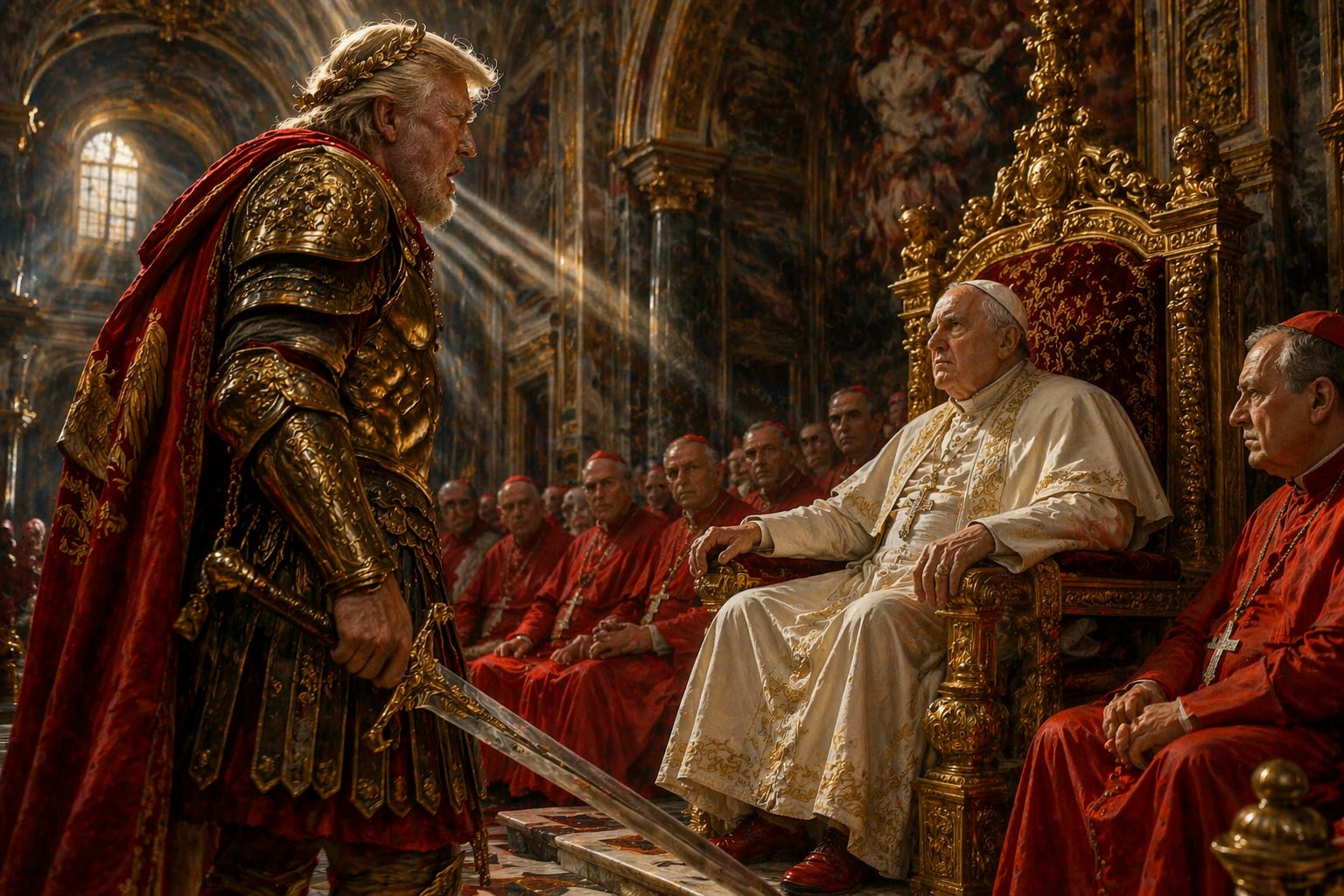
Inevitably, much of this conflict is organized along the familiar right/left schism in modern politics.
On the left, until quite recently, there have tended to be fewer true free swords and a broader network to affiliate with. Rather than rallying around a single sovereign figure, authority is distributed across institutions—universities, media organizations, foundations, even corporations—each conferring its own form of legitimacy. Power flows through a web of credentials, reputations, and overlapping domains of influence. This produces more sworn knights. Like the Templars and Hospitallers of old, these actors are not bound to a single ruler but to an institutional order. Allegiance is indirect: one does not serve a single liege, but operates within—and in support of—the system’s interlocking structures.
The modern right, by contrast, tends more toward personal consolidation. It seeks to rally behind a smaller number of leaders and relies more heavily on traditional institutions, such as churches, to organize its members. Its frameworks are generally more straightforward and easier to grasp. In the US and beyond, it has repeatedly attempted to coalesce around Donald Trump, but his mercurial, erratic style has made it difficult to fully stabilize a movement around him.
The resulting dynamic is less like empire versus empire, and closer to Empire versus Papacy: a struggle over where legitimacy ultimately resides. One side tends toward concentration in a singular, visible authority; the other disperses authority across institutions, credentials, and narratives.
This is a schism within the West, not unlike earlier fractures in its intellectual and religious history. What is at stake is not simply policy or preference, but competing ways of grounding authority itself.
Our current situation can be understood as a tension between what might be called an embodied mode of legitimacy and an abstracted one. Both draw, in different ways, on the Western intellectual inheritance going back to Plato and Aristotle, but they organize it differently: one through lived continuity and particularity, the other through abstraction and generalization.
In practice, the distinction is easy to recognize. The embodied mode grounds legitimacy in place, continuity, and lived experience—what has worked for people in specific contexts. The abstracted mode grounds it in general principles that aim to apply across contexts, independent of place or history.
This tension is not reducible to left versus right. Both modes exist within each tradition, and both are necessary. The abstracted mode enables coordination at scale, allowing societies to operate across distance and difference. The embodied mode preserves local knowledge and constraint, grounding systems in reality. The problem is not the existence of either mode, but the breakdown of their balance.
Luxury beliefs emerge more naturally from the abstracted mode. Because they are grounded in general principles rather than local consequences, they can be adopted, refined, and signaled without direct exposure to their real-world effects.
The embodied mode resists this dynamic. It evaluates ideas not by their internal coherence alone, but by their observed consequences in specific contexts. This makes it slower to update, but also less tolerant of beliefs that impose externalized costs.
The Internet of Beefs serves as the arena in which these modes interact, translate, and collide.
The Internet of Beefs amplifies the most legible versions of both modes. The abstracted mode is pushed toward ever more extreme generalization—principles detached from constraint, optimized for clarity and moral force rather than practical viability. The embodied mode, in turn, is pushed toward reaction—defining itself less by what it preserves than by what it opposes, often collapsing into nostalgia or identity assertion.
In both cases, the underlying traditions are flattened into more performative, less generative forms.
Not surprisingly, this asymmetry is a central theme in the online melee itself.
The struggle is between an Embodied West and an Abstracted West. It is a struggle between a West of people, traditions, and places, and a West of natural laws, universal ideals, and aspirational coherence. Both are real strands within the Western tradition, but on the Internet of Beefs, the most caricatured and least compromising versions of each are pushed to the fore.
How do Individual Lords, Knights, and Mooks Pick Sides?
To understand this, it’s essential to recognize how intra-elite conflict contributes to individual positioning within social networks. The goal is not survival but relative status: standing, influence, and importance among near peers. In such settings, the challenge is not simply about acquiring resources but about differentiating oneself.
Material signals such as wealth, titles, and consumption remain necessary at elite levels, but they are no longer sufficient. Because they are widely shared within the competitive set, their ability to distinguish among near-peers is limited. When everyone credible possesses them, they provide little information about relative standing.
Under these conditions, competition shifts toward signals that are more legible, dynamic, and capable of finer distinctions. This is where “luxury beliefs” emerge: not as a substitute for material status, but as a higher-resolution layer that allows individuals to differentiate themselves within an already rarefied group. Beliefs perform this role especially well because they are publicly expressed, easily updated, and allow for continuous gradation: who holds the “right” view, who holds it more strongly, who arrived at it earlier, and who is willing to enforce it.
As I discussed in Signals All The Way Down, competition does not fade as societies advance; it simply migrates into more symbolic domains.

At this point, an obvious question arises: if the majority of elites—Hollywood, academia, media—share the same general beliefs, how do those beliefs differentiate individuals? The answer is that they operate on two levels.
First, as membership signals, adopting the dominant elite framework grants access, while refusal to adopt it leads to exclusion. At this level, the point is not distinction but belonging. The core set of orthodox beliefs functions as a marker that one belongs within elite strata at all. Luxury beliefs are especially effective in this role because they are often difficult or costly for non-elite groups to live with in practice.
Second, once one is inside the elite group, differentiation reappears through how beliefs are held: their intensity, timing, articulation, enforcement, and extension into new areas. The real contest is therefore not simply over which beliefs people hold, but over how they hold them.
Rob Henderson’s concept of “luxury beliefs” helps clarify why this matters. As material differentiation becomes less informative within elite circles, symbolic positioning becomes more important. In the attention economy, high-status symbolic positioning can itself amplify wealth, influence, and visibility, especially in media and adjacent sectors.

Performing revolutionary identity in a high-budget cultural production signals an edgy form of high-tier elite status while shifting the physical risks and costs of revolutionary activity onto the mooks it inspires to take up arms in the real world.
The Great Separation
Luxury beliefs represent an inversion well captured by the line from the cult film Withnail and I:

Luxury beliefs are cheap for elites to adopt because elites are often insulated from their practical consequences. For non-elite communities, however, those same beliefs can carry real costs. This asymmetry is precisely what gives luxury beliefs their signaling power. By adopting beliefs whose consequences they are largely shielded from, elites implicitly signal distance from constraint—their ability to absorb, evade, or externalize costs that would bind others.
Luxury beliefs are therefore a remarkably efficient status signal, but only for those protected enough to bear them lightly.
Conclusion
What emerges from this analysis is not simply a new way of understanding online conflict, but a clearer view of the structural conditions shaping it.
The Internet of Beefs is not an accidental byproduct of social media. It is the natural expression of intensified intra-elite competition within a system optimized for attention. Luxury beliefs are not aberrations, but one of the system’s most efficient signaling mechanisms. Together, they describe how competition for status, influence, and legitimacy now unfolds in increasingly symbolic and performative domains.
But the implications extend beyond status games.
As became clear in a recent live discussion on cognitive warfare with Claire Berlinski, Renee DiResta, and Bianka @ Waronomics, these same dynamics are being actively exploited by external actors. Foreign influence campaigns do not need to invent new narratives; they amplify existing grievances, insert themselves into ongoing conflicts, and rely on domestic participants to propagate their messaging. The Internet of Beefs provides both the medium and the mechanism for this process. What appears as organic conflict is often structurally indistinguishable from targeted subversion.
This creates a system that is both highly dynamic and deeply fragile.
Highly dynamic, because it continuously generates new conflicts, identities, and symbolic distinctions. Yet also fragile, because it depends on a shared epistemic foundation that is steadily eroding. The collapse of logical positivism did not simply fragment philosophy; it weakened institutions' ability to anchor claims in a shared framework of truth. In its absence, coherence becomes something performed rather than demonstrated, and legitimacy shifts from correspondence with reality to resonance within a network.

In such an environment, conflict cannot easily be resolved. It can only be sustained, redirected, or amplified.
This helps explain why the Internet of Beefs appears both chaotic and stable at once. Participants are not primarily seeking truth or resolution. They are competing to define the boundaries of legitimacy itself: what can be said, what must be believed, and who has the authority to decide.
The result is a system that increasingly struggles to distinguish between internal competition and external attack, between genuine disagreement and engineered conflict, between belief and performance.
None of the mitigation strategies discussed—algorithmic reform, media literacy, institutional rebuilding—is likely to succeed in isolation. Each addresses part of the problem, but the underlying dynamics remain intact. The system will continue to generate conflict so long as the structural conditions that sustain it persist.
The deeper challenge is therefore not simply to reduce misinformation or dampen outrage, but to restore the conditions under which disagreement can once again become generative rather than purely performative.
This requires more than better rules or better tools. It requires a rebalancing between the embodied and abstracted modes of legitimacy: between lived experience and general principle, between local knowledge and universal claims, between constraint and coherence.
Without that balance, the system will continue to drift toward ever more refined forms of symbolic conflict: conflict that feels meaningful to those inside it, but increasingly fails to produce useful outcomes.
When that happens, conflict does not disappear. It escalates.
We are now at a point where the boundary between symbolic conflict and real conflict is breaking down—and the consequences are no longer abstract.
I welcome your comments, observations, and questions. I try to reply to all comments.
We should always be suspicious of grievance politics: people proclaiming their victimhood are trying to leverage weakness, and that's neither noble nor admirable. But the schism of the elites (which is intermittently playing out online) is certainly one of the defining events of our age.
You can tell that this is the case... because the mainstream is almost completely silent on it. That's a sure sign of a very important cultural development.
https://jmpolemic.substack.com/p/the-schism-of-the-elites
Make an AI agent, run and controlled by a DAO, to be a new kind of Knight. DAO of mooks. Gain status collectively